
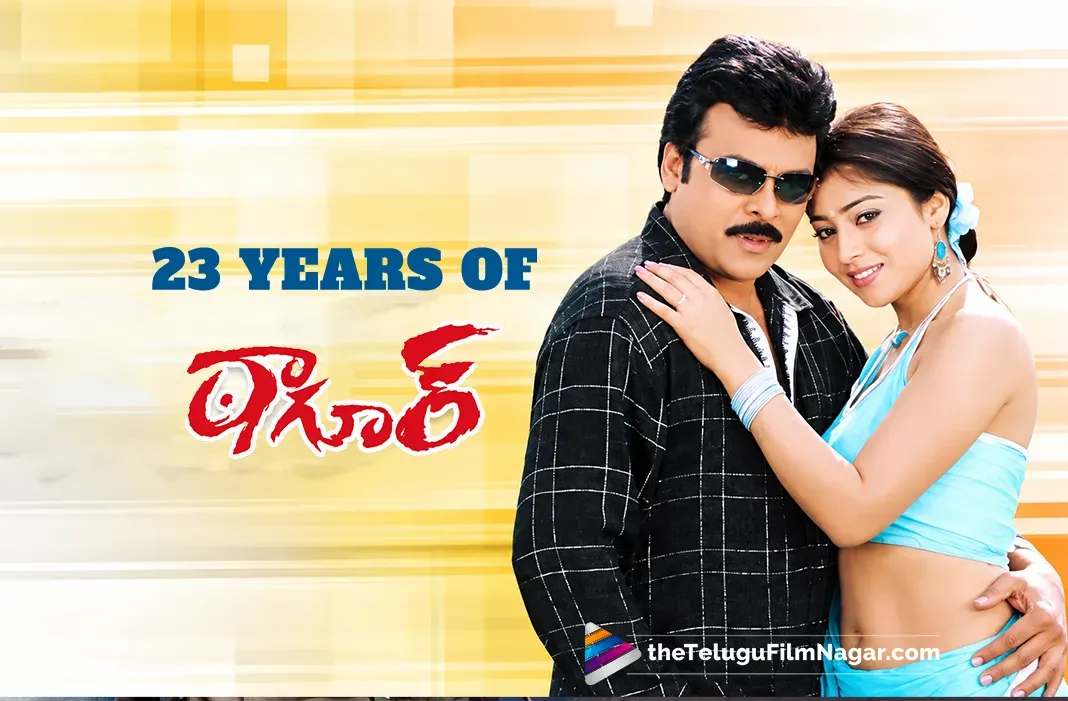
Tagore completes 23 years today, marking the anniversary of one of Chiranjeevi’s memorable social-action dramas. Released on September 24, 2003, the film was directed by V. V. Vinayak and featured Chiranjeevi in the lead, alongside Jyothika, Shriya Saran and Prakash Raj. Mani Sharma composed the music, Chota K. Naidu handled the cinematography and the Paruchuri Brothers wrote the dialogues. The film was produced by B. Madhu under Leo Projects.
At the centre of Tagore is Ravindranath Tagore, a professor who takes up a dangerous fight against corruption. After a personal tragedy exposes how corruption can destroy ordinary lives, Tagore decides that simply speaking about the problem is not enough. He forms the Anti-Corruption Force (ACF) with his former students, who gather information about corrupt officials and help him take action against them. The police begin investigating the mysterious operations, eventually leading to the discovery of Tagore’s identity.
The anti-corruption theme remains the film’s biggest strength. Rather than presenting corruption as a background issue, Tagore makes it the central conflict and builds its entire narrative around one man's extreme response to a system he believes has failed. The ACF concept gave the story a distinctive hook, while episodes such as the hospital sequence turned the social message into dramatic commercial cinema. The film's approach was direct, allowing its central idea to reach audiences without losing the larger-than-life appeal associated with Chiranjeevi.
Chiranjeevi's performance is another major reason the film remains memorable. He moves between the composed professor in the flashback portions and the determined crusader in the main narrative, giving the character both emotional depth and mass appeal. Prakash Raj's investigation as Suryam adds another layer to the story, while Jyothika's role gives emotional weight to Tagore's past. Shriya Saran, Sayaji Shinde, Kota Srinivasa Rao, Sunil, M. S. Narayana and others form an important supporting cast.
Vinayak's direction also played a key role in making a serious subject accessible as a mainstream entertainer. The film uses action, emotion, dialogue, music and crowd-driven moments to keep the narrative moving. Mani Sharma's background score further strengthens several of the film's dramatic sequences. Contemporary reviews particularly noted Vinayak's stylish presentation and the way the screenplay created a strong commercial framework around a simple social theme.
What makes Tagore continue to stand out after 23 years is the clarity of its central idea. The film came at a time when corruption was already a familiar concern for audiences, but it turned that everyday frustration into a larger cinematic conflict. Its methods may be extreme within the story, but the underlying message about the damage caused by corruption remains easy to understand.
That combination of Chiranjeevi's screen presence, Vinayak's commercial treatment, a strong supporting cast and a socially relevant core gave Tagore a distinct place in Telugu cinema. Even after more than two decades, its ACF concept, powerful dialogues, emotional flashback and Chiranjeevi's portrayal of Tagore continue to make the film a memorable chapter in his filmography.